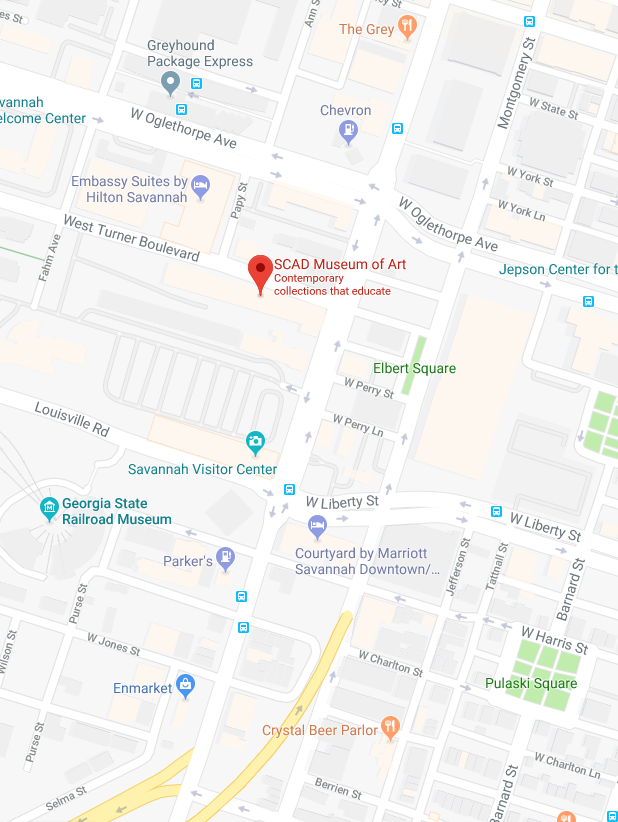
The SCAD Museum of Art
The SCAD Museum of Art is a premier contemporary art museum that features emerging and established international artists through commissioned works and rotating exhibitions; engages local communities with special initiatives of an international scope; and serves as a resource for SCAD students and alumni during their academic careers and beyond.
As a center for cultural dialogue, SCAD MOA engages students through dynamic interdisciplinary educational experiences. A growing international roster of artists provides opportunities for students from all majors to learn about wide-ranging artistic practices and world views.
The museum has presented exhibitions by artists including Jane Alexander, Radcliffe Bailey, Janet Cardiff and George Bures Miller, Carlos Cruz-Diez, Subodh Gupta, Alfredo Jaar, Sigalit Landau, Liza Lou, Ebony G. Patterson, Robin Rhode, Bill Viola, Carrie Mae Weems, Kehinde Wiley and Fred Wilson, as well as site-specific installations by Daniel Arsham, Kendall Buster, Jose Dávila, Michael Joo, Odili Donald Odita and others. The museum's permanent collection includes the Walter O. Evans Collection of African American Art, the Modern and Contemporary Art Collection, the Earle W. Newton Collection of British and American Art, the 19th- and 20th-century Photography Collection and the SCAD Costume Collection.
An award-winning, architectural icon, the museum incorporates the oldest surviving antebellum railroad depot in the U.S. into its striking design. Nestled in the heart of Savannah's vibrant historic downtown district, the museum attracts visitors from around the globe. It has been recognized by the Georgia Trust for Historic Preservation, the Congress for the New Urbanism, the International Interior Design Association and the Historic Savannah Foundation, and received the American Institute of Architects Honor Award for Architecture, a pinnacle achievement.
The building and its history
SCAD MOA is a radiant example of the university's legacy of innovative building adaptation and reuse. Since 1978, SCAD has revitalized more than 100 structures in Savannah and Atlanta, Georgia; Lacoste, France; and Hong Kong.
SCAD MOA is housed in an 1853 brick structure that was once a railway depot for the Central of Georgia Railway. This National Historic Landmark is the only surviving antebellum railroad complex in the U.S. The museum has breathed life into these ruins, which once extended more than 800 feet along Turner Boulevard's southern frontage.
Originally conceived as a major trade post for Savannah, the railroad complex was occupied by Union troops at the close of the Civil War. In the early 20th century, the area surrounding much of the Central of Georgia Railroad buildings emerged as an important African American commercial district and cultural hub, and remained so through the mid-20th century. Despite its prime location and significant pedigree, the complex was beset by five decades of neglect, and by the late 20th century, the depot and its precious Savannah gray brick lay in ruins. Yet, a wealth of natural beauty and possibility remained, sparking SCAD's commitment to its students and to the Savannah community at large.
Following a groundbreaking ceremony in January 2010, SCAD architects, designers and craftsmen integrated the building's history with its bright new future, analyzing and reproducing key original components down to the chemical compounds in the 19th-century mortar. The ethos of the rehabilitated SCAD MOA is best articulated by its glittering atrium, an 86-foot-high steel and glass lantern featuring the first beacon that welcomes visitors and elegantly redefines the Savannah city skyline.
Wherever possible, museum designers and architects used sustainable, renewable materials and employed the very best in energy-saving technologies. At present, the museum is outfitted with low-energy-consuming light fixtures, zoned climate control, exterior cooling towers, low-flow plumbing fixtures for water-use reduction and low-emissivity (low-E) glass on the south elevation. Landscape planning for the courtyard made use of xeriscape planning, porous paving materials and custom irrigation plans.
Salvaged bricks and original heart pine timbers appear throughout the museum, and the original high ceilings, most of which were kept, allow for optimal temperature regulation and provide a dramatic background for the display and experience of art.
The expansion
The landmark rehabilitation of SCAD MOA, the largest project of its kind in SCAD history, has advanced the university's award-winning legacy of adaptive reuse and urban revitalization. The $26 million expansion added 65,000 square feet to the former museum facility, and the building now features many notable design elements including a prominent entrance marked by an 86-foot-high steel and glass lantern; a contradistinctive façade uniting original 19th-century Savannah gray brick with modern composite materials; a manicured courtyard and streetscape; outdoor lecture and performance spaces; and an events terrace and adjoining atrium. Inside, the expansion allows the museum to present engaging exhibitions and installations from renowned and emerging artists, as well as showcase works from the university's diverse permanent collection. Much of the museum's expansion has focused on art stewardship, as evidenced by dedicated areas for shipment, quarantine, framing and de-framing, and curatorial supply storage.
Awards
Since opening its doors in October 2011, the renovated museum has been celebrated for its inspired architecture and design, world-class exhibitions and visionary community outreach and education programs that enrich art enthusiasts, educators and students of all ages. SCAD is proud to be recognized by the following awards:
- AIA Institute Honor Award for Architecture
- Congress for the New Urbanism, Charter Award
- International Interior Design Association (IIDA)-Georgia chapter
- Best of the Best Forum Design Award and Best of the Best Forum Award (education category)
- American Concrete Institute-Georgia chapter First Place in Restoration Category
- American Institute of Architects-Savannah chapter Honor Award (top honor awarded)
- AIA South Atlantic Region, Design Award
- Historic Savannah Foundation, Preservation Award
- Southeastern Museums Conference Publication Competition Gold Award for SCAD MOA Curriculum Guide
- Southeastern Museums Conference Exhibition Competition Certificate of Commendation for the outstanding exhibit "Pose/Re-pose: Figurative Works Then and Now"

SCAD MOA honors William and Ellen Craft
As part of SCAD deFINE ART 2016, the Savannah College of Art and Design honored two important figures in American history. In celebration of William and Ellen Craft and their daring escape from slavery, the university commissioned and installed a commemorative bronze medallion — designed by SCAD alumnus and foundation studies professor Andrew MacDonald (M.F.A., illustration, 2014) — in the lobby of SCAD MOA.
In 1848 the Crafts, an enslaved African-American couple, escaped from their masters in Macon, Georgia, to embark on a perilous four-day journey to the Northern free states. To make their escape, they devised a plan for fair-skinned Ellen to pose as a deaf, white male slave owner and William as her attendant slave. Upon completing the first stage of their journey, the Crafts arrived in Savannah, passing through the Central of Georgia Railway depot — the very place where SCAD MOA stands today.
Dr. Walter O. Evans, a member of the Ruskin Society and benefactor of SCAD MOA's Walter O. Evans Collection of African American Art, originally shared the story of the Crafts with President Wallace during SCAD MOA's expansion in 2011. Dr. Evans added, "This acknowledgment by SCAD — recognizing the passage of the Crafts through this place that today stands as an educational and cultural junction of the highest order — is a perfect illustration of how SCAD rises to every occasion, taking care to celebrate narratives both well-known and lesser known so that we all might share in the universality of the human experience."
View the lesson plan as part of your educational experience.

Museum footprint
SCAD MOA boasts an ingenious use of space to give visitors and students the optimum viewing experience.
82,118 square feet
total complex space
19,943 square feet
gallery space
232,050 square feet
total outdoor space
11,481 square feet
academic space
3,298 square feet
theater space