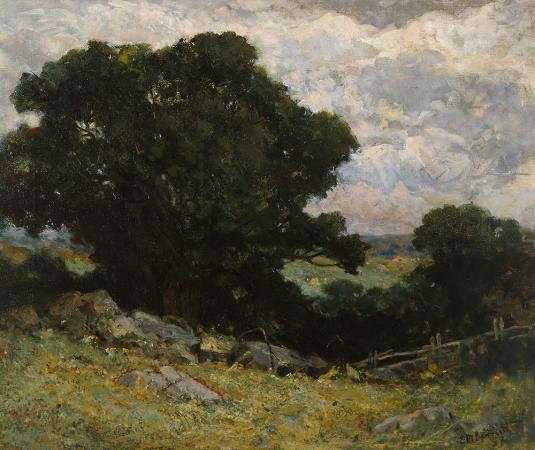
Landscape
Painter Edward Mitchell Bannister found much of the inspiration for his paintings in the seascapes and landscapes of New England. He maintained a keen interest in the French Barbizon School and in the work of artist Jean-François Millet. Accordingly, Bannister was known for using a tonalism style (which emphasizes mood and shadow) in the rendering of his pastoral scenes. His technique often involved building up the surface of his works through heavy, dense brush strokes in what was often deemed Impressionist style painting. Bannister's preference for landscapes adorned with trees and rolling hills as seen here in "Streamside" (1870), "Landscape" (1897) and "Summer Twilight" (1899) recalls the 19th-century tradition of the Hudson River School, whose oeuvre captured the sprawling vastness of America's natural terrain.
The Walter O. Evans Collection of African American Art
One of the most important collections of African American visual art dating from the 18th century to the present, the collection includes 62 works from Edward Bannister, Romare Bearden, Elizabeth Catlett, Robert S. Duncanson, Richard Hunt, Jacob Lawrence and others. This collection forms the foundation of a multidisciplinary center for the study, understanding and appreciation of African American art and culture. Items from the collection have previously rotated in the Evans Center Gallery and through unique exhibitions such as the 2012 "Life's Link: A Fred Wilson Installation," and the 2017 travelling exhibition of Jacob Lawrence's work.