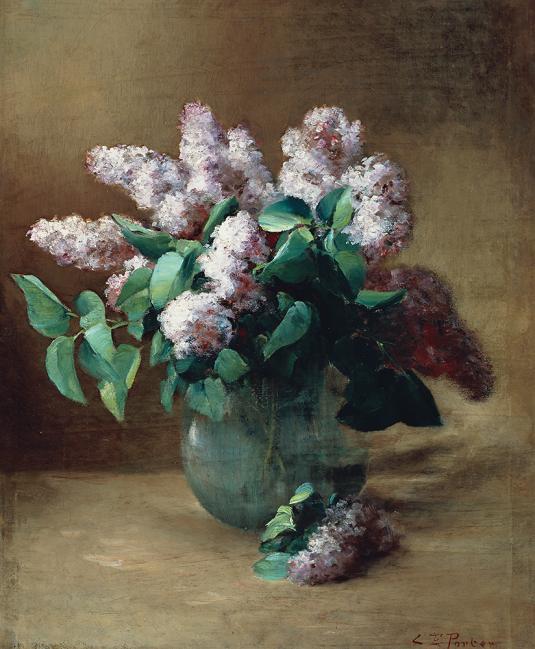
Lilacs
Considered one of the best still-life painters of the late 19th century, Charles Ethan Porter found much of his inspiration in the varied natural landscapes of his home state of Connecticut. Relying on the use of rich colors and active, delicate brushwork as well as giving strong attention to detail, Porter's works conveyed a quiet vibrancy of the natural world around him.
Porter was most well known for his floral paintings, at a time when only a few American artists focused on this subject, due in part to the heavy European still-life tradition. In "Lilacs," Porter removes any background elements that might distract from the celebration of the beauty of his floral centerpiece. In contrast to the hyper-realism of the Dutch still-life tradition, with its minute brushstrokes and sharp, bright colors, Porter places an emphasis on his brushwork, letting their visibility build up the surface of the painting to convey a sense of life and energy to the flowers even as they start to fall. He also uses a softer palette, to relay the fragile and delicate state of these living specimens.
The Walter O. Evans Collection of African American Art
One of the most important collections of African American visual art dating from the 18th century to the present, the collection includes 62 works from Edward Bannister, Romare Bearden, Elizabeth Catlett, Robert S. Duncanson, Richard Hunt, Jacob Lawrence and others. This collection forms the foundation of a multidisciplinary center for the study, understanding and appreciation of African American art and culture. Items from the collection have previously rotated in the Evans Center Gallery and through unique exhibitions such as the 2012 "Life's Link: A Fred Wilson Installation," and the 2017 travelling exhibition of Jacob Lawrence's work.