11 a.m.
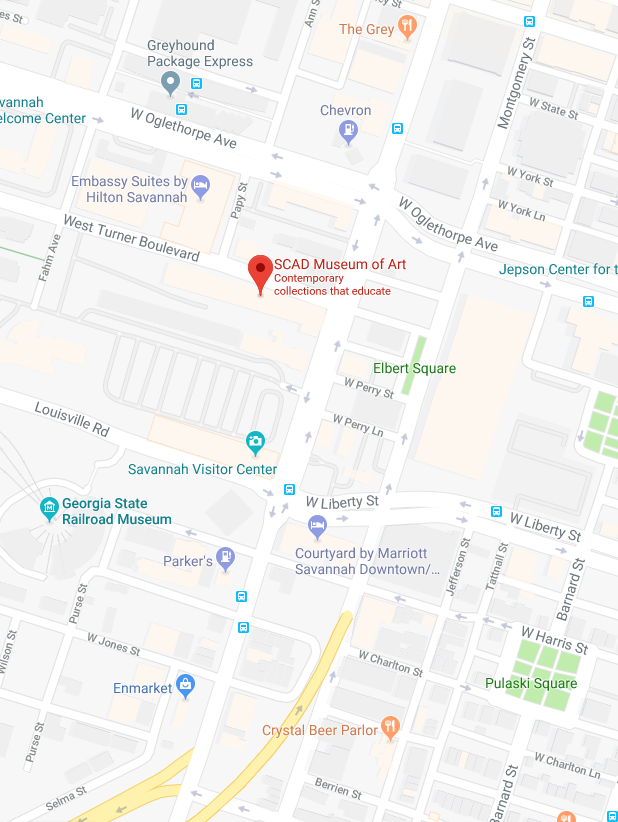
SCAD Museum of Art
601 Turner Blvd.
Savannah, Georgia
This event is free and open to the public and presented as part of SCAD deFINE ART 2023.
Join artists Ann Craven and Chase Hall in the galleries for conversations on their respective exhibitions, moderated by SCAD Museum of Art chief curator Daniel S. Palmer. Craven and Hall each will discuss their singular practices, as well as the methods and themes present in the works on view. Craven will share the process of creating her paintings, from the small plein air canvases she makes by moonlight to the panorama-like installation that constitutes the largest exhibition of these works to date. Hall will illuminate his innovative figurative painting techniques and the range of social and historical issues his works address, as well as his impressive presentation at the museum.
About the artists
Ann Craven (b. 1967, Boston, Mass.) is known for her lush, serial portraits of the moon, birds, and flowers, as well as her painted bands of color. After completing each work, she dates and titles each palette, rendering it a unique and isolated index of her process. Craven’s predilection for the copy — both from referent photographs and from her own plein air paintings — is both an homage to Pop Art and an exploration of remembrance. As she explains, “My paintings are a result of mere observation, experiment, and chance, and contain a variable that is constant and ever-changing — the moment just past.” Craven presented her first retrospective, titled TIME and curated by Yann Chevalier, at Le Confort Moderne in Poitiers, France, in 2014. Recent solo exhibitions include Karma, New York; the Center for Maine Contemporary Art, Rockland; Shane Campbell Gallery, Chicago; Southard Reid, London; and Maccarone, New York, among others. Craven’s paintings are held in the public collections of The Museum of Modern Art, New York; The Whitney Museum of American Art, New York; Colby College Museum of Art, Waterville, Maine; Farnsworth Art Museum, Rockland, Maine; and the Museum of Contemporary Art Chicago, among others.
Chase Hall’s (b. 1993, St. Paul, Minn.) paintings and sculptures respond to generational celebrations and traumas encoded throughout American history. Contending with a variety of social and visual systems, each of which intersects with complex trajectories of race, hybridity, economics, and personal agency, Hall generates images whose materiality is as crucial to their compositional makeup as their indelible approach to representation. A central body of paintings, made with drip-brew techniques derived from coffee beans and acrylic pigments on cotton supports, is notable for both its conceptual scope and its intimacy. The use of brewed coffee carries powerful symbolic weight as it evokes centuries-old geopolitical systems associated with the commodification of a plant native to Africa. In Hall’s hands, it also becomes a means of achieving subtle visual textures, a range of brown skin tones, and a mark-making vocabulary precipitated on the closeness of touch. Above all, it is the artist’s improvisational willingness to immerse himself in the indefinable personal hieroglyphics of each picture that gives his work its resonance and impact.